
Healthcare organizations today face increasing financial pressure due to rising operational costs, stricter payer policies, growing claim denials, and changing reimbursement models. As a result, healthcare revenue cycle management has become one of the most critical components of maintaining profitability and operational stability.
Modern revenue cycle management is no longer limited to submitting claims and collecting payments. It now involves automation, medical coding accuracy, denial prevention, analytics, compliance management, patient financial engagement, and workflow optimization. Healthcare providers that fail to modernize their RCM processes often struggle with delayed reimbursements, administrative inefficiencies, and revenue leakage.
Industry research suggests the global healthcare revenue cycle management market is expected to grow significantly over the next several years as providers increasingly adopt AI-powered billing technologies and outsourced RCM services to improve financial outcomes and reduce operational burdens.
At AffinityCore, we help healthcare organizations improve reimbursement accuracy, reduce claim denials, accelerate collections, and optimize their entire revenue cycle through comprehensive medical billing and RCM solutions.
Take control of your healthcare revenue cycle with smarter billing, faster collections, and fewer denials. Schedule a Call
What Is Revenue Cycle Management in Healthcare?
Revenue cycle management (RCM) refers to the complete financial process healthcare providers use to track patient revenue from appointment scheduling through final payment collection. It combines administrative, financial, and clinical processes to ensure providers receive accurate reimbursement for the care they deliver.
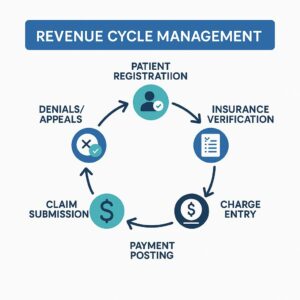
The healthcare revenue cycle includes patient registration, insurance eligibility verification, medical coding, claims submission, payment posting, denial management, and patient collections. Every stage directly impacts a provider’s financial performance, operational efficiency, and patient experience.
Healthcare organizations rely on efficient revenue cycle management to reduce billing errors, minimize claim denials, improve cash flow, and maintain compliance with payer and government regulations. Without a strong RCM strategy, providers often experience delayed reimbursements, rising accounts receivable, and increased administrative costs.
Why Revenue Cycle Management Is More Important Than Ever
The healthcare industry has become increasingly complex over the last decade. Providers must now manage changing payer regulations, value-based reimbursement models, prior authorization requirements, staffing shortages, and increasing patient financial responsibility.
At the same time, patients are paying larger portions of their healthcare expenses through high deductibles and copays. This shift has forced healthcare organizations to focus more heavily on patient collections and financial transparency.
An optimized revenue cycle management strategy helps healthcare providers improve clean claim rates, reduce denials, accelerate reimbursements, and lower administrative burdens. Efficient RCM processes also improve patient satisfaction by simplifying billing communication and creating a smoother financial experience.
Healthcare organizations that invest in automation and advanced billing technologies often achieve significantly better operational and financial outcomes compared to providers relying on outdated manual processes.
Understanding the Healthcare Revenue Cycle Process
Patient Scheduling and Registration
The revenue cycle begins when a patient schedules an appointment. During registration, healthcare providers collect demographic information, insurance details, referral data, consent forms, and medical history documentation.
Front-end registration accuracy plays a major role in preventing billing issues later in the process. Even minor demographic or insurance errors can result in claim rejections, payment delays, and increased administrative rework.
Modern healthcare organizations increasingly use digital intake systems and automated eligibility verification tools to improve registration accuracy and reduce front-office workload. These technologies help create a smoother patient experience while minimizing preventable claim issues.
Insurance Eligibility Verification
Insurance verification ensures that a patient’s coverage is active and confirms details such as copays, deductibles, coinsurance responsibilities, and authorization requirements before services are rendered.
Failure to verify eligibility properly is one of the leading causes of claim denials and delayed reimbursements in healthcare billing. Accurate eligibility checks help providers reduce financial risk while improving upfront patient collections.
Advanced RCM systems now use automation and real-time payer integrations to streamline eligibility verification processes. This reduces manual administrative work and helps billing teams identify potential insurance issues before claims are submitted.
Medical Coding and Charge Capture
Medical coding transforms clinical documentation into standardized billing codes used for reimbursement. Accurate coding is essential because payer reimbursement depends heavily on proper diagnosis and procedure coding.
Coding errors, incomplete documentation, missing modifiers, and inaccurate charge capture can significantly impact reimbursement rates and compliance. These issues may also increase the likelihood of audits and claim denials.
Healthcare organizations that prioritize coding accuracy through audits, training, and specialized billing support often experience stronger reimbursement performance and fewer compliance-related risks. Proper charge capture also helps prevent revenue leakage caused by missed billable services.
Claims Submission and Processing
After coding and charge entry are completed, claims are electronically submitted to insurance payers for processing. A clean claim contains accurate patient information, proper coding, supporting documentation, and all required authorization details.
Claim submission accuracy directly affects reimbursement timelines and operational efficiency. Rejected or denied claims create delays, increase administrative labor, and reduce cash flow.
Many healthcare providers now use claim scrubbing software and AI-powered billing systems to identify claim errors before submission. These technologies help improve first-pass acceptance rates and reduce denial-related rework.
Payment Posting and Reconciliation
Once claims are processed, insurance companies issue reimbursements along with explanations of benefits and remittance advice documents. Payment posting ensures these reimbursements are accurately applied to patient accounts.
Reconciliation processes help healthcare organizations identify underpayments, overpayments, missing reimbursements, and payer discrepancies. Without proper reconciliation, providers may lose revenue opportunities or overlook payment inaccuracies.
Strong payment posting workflows improve financial visibility and help billing teams track reimbursement trends more effectively. Accurate reconciliation also supports stronger financial reporting and revenue forecasting.
Partner with AffinityCore to simplify revenue cycle management. Audit Your Data Now
Denial Management and Appeals
Claim denials remain one of the largest financial challenges in healthcare revenue cycle management. Denied claims increase administrative workload, delay reimbursements, and create unnecessary revenue loss.
Common denial causes include coding mistakes, missing authorizations, eligibility problems, duplicate billing, and insufficient documentation. Many providers lose significant revenue because denied claims are never appealed or corrected properly.
A strong denial management strategy focuses on identifying root causes, preventing recurring billing errors, and improving claim accuracy before submission. Advanced analytics and automation tools now help providers proactively identify high-risk claims and reduce denial rates.
Patient Billing and Collections
Patient financial responsibility has increased substantially in recent years, making patient collections a more important component of healthcare revenue cycle management.
Modern patients expect transparent billing, digital payment options, and flexible payment arrangements. Complicated billing processes often create confusion, delayed payments, and dissatisfaction.
Healthcare organizations that improve financial communication and simplify billing experiences often achieve higher collection rates and stronger patient relationships. Online payment portals, automated reminders, and upfront cost estimates can significantly improve payment performance.
Major Challenges in Healthcare Revenue Cycle Management
Healthcare providers continue to face several financial and operational challenges that directly impact revenue cycle performance. Rising claim denials, staffing shortages, changing payer regulations, and increasing compliance requirements have made healthcare billing significantly more complex.
Many organizations also struggle with outdated billing systems and fragmented workflows that reduce efficiency and create revenue leakage. Small administrative errors can quickly lead to delayed reimbursements and increased accounts receivable.
Another major challenge involves maintaining compliance with evolving healthcare regulations and payer policies. Failure to meet documentation and billing standards can result in audits, penalties, and denied claims.
As patient financial responsibility continues to grow, providers must also improve patient billing transparency and collection strategies to maintain stable cash flow.
Key Revenue Cycle Management KPIs
Monitoring revenue cycle metrics is essential for measuring financial performance and identifying operational inefficiencies. Healthcare organizations use several key performance indicators to evaluate the effectiveness of their RCM processes.
Days in accounts receivable measures how quickly providers collect payments after services are rendered. Lower A/R days generally indicate stronger billing efficiency and healthier cash flow.
Clean claim rate measures the percentage of claims accepted on the first submission without errors or rework. High clean claim rates reduce administrative costs and accelerate reimbursements.
Denial rate is another critical KPI because it reflects billing accuracy and payer compliance. Healthcare organizations with lower denial rates often experience better overall financial performance.
Net collection rate and first-pass resolution rate also provide valuable insight into how effectively providers collect revenue and manage claim processing workflows.
How Technology Is Transforming Revenue Cycle Management
Technology is rapidly reshaping healthcare revenue cycle management by improving automation, analytics, and operational efficiency. Modern RCM platforms now integrate electronic health records, billing systems, clearinghouses, and payment processing tools into unified workflows.
Artificial intelligence and predictive analytics are helping providers identify denial risks, automate repetitive billing tasks, and improve claim accuracy before submission. These technologies reduce manual workload while increasing operational consistency.
Cloud-based billing systems also provide healthcare organizations with greater flexibility, scalability, and financial visibility. Real-time reporting and analytics help providers monitor revenue trends and make faster operational decisions.
Healthcare organizations that adopt advanced RCM technologies are often better positioned to improve reimbursement performance and reduce administrative inefficiencies.
In-House vs Outsourced Revenue Cycle Management
Many healthcare providers eventually face the decision of whether to manage revenue cycle operations internally or outsource them to specialized RCM companies.
In-house billing offers greater operational control but often requires significant investments in staffing, training, compliance management, and billing technology. Maintaining experienced billing teams can become expensive and difficult, especially during staffing shortages.
Outsourced revenue cycle management allows providers to access experienced billing specialists, advanced technologies, and scalable operational support without expanding internal administrative teams.
Healthcare organizations that outsource RCM services often improve collections, reduce denials, and lower operational costs while allowing providers to focus more heavily on patient care and clinical operations.
Best Practices for Optimizing Revenue Cycle Management
Healthcare organizations can significantly improve financial performance by implementing proactive revenue cycle optimization strategies. Automation is one of the most effective ways to reduce manual errors and streamline administrative workflows.
Improving documentation accuracy and coding quality also plays a major role in reducing denials and maximizing reimbursement rates. Ongoing staff training and billing audits help providers maintain compliance and improve operational consistency.
Denial prevention should remain a priority because correcting denied claims is far more expensive than preventing errors before submission. Providers should regularly analyze denial trends and payer-specific billing patterns.
Healthcare organizations should also focus on improving patient financial communication through transparent billing practices, cost estimates, and convenient digital payment solutions.
Why Healthcare Providers Choose AffinityCore
At AffinityCore, we provide comprehensive healthcare revenue cycle management services designed to improve financial performance, reduce claim denials, and optimize billing operations.
Our experienced RCM specialists help healthcare organizations streamline insurance verification, medical coding, claims management, payment posting, accounts receivable follow-up, and denial resolution processes.
We work with private practices, specialty clinics, behavioral health providers, rehabilitation facilities, and healthcare organizations of all sizes. Our goal is to simplify complex billing operations while helping providers maximize reimbursement and maintain financial stability.
By combining industry expertise, automation, analytics, and customized billing solutions, we help healthcare organizations improve operational efficiency and strengthen long-term revenue performance.
Final Thoughts
Revenue cycle management has become one of the most important operational functions within modern healthcare organizations. Efficient RCM processes directly impact cash flow, profitability, compliance, patient satisfaction, and long-term organizational growth.
As healthcare reimbursement models continue evolving, providers must adopt smarter billing strategies supported by automation, analytics, and experienced revenue cycle specialists. Organizations that fail to modernize their RCM operations often struggle with rising denials, delayed reimbursements, and increasing administrative costs.
Healthcare providers that invest in optimized revenue cycle management gain stronger financial stability, better operational efficiency, and improved patient financial experiences.
If your organization is experiencing billing inefficiencies, claim denials, aging accounts receivable, or reimbursement delays, AffinityCore Revenue Cycle Management Services can help improve your revenue cycle performance and financial outcomes.
Streamline your medical billing operations with AffinityCore RCM experts